Newton’s Formula For Speed of Sound In Gas-
Before you go through this article, make sure that you have gone through the previous article on Newton’s Formula For Speed of Sound in Gas.
We have learnt that-
- Newton suggested that when a sound wave travels through a gaseous medium, the medium undergoes an isothermal process.
- In isothermal process, the bulk modulus of gas is equal to the pressure of the gas.
- He replaced the bulk modulus of gas with the pressure of the gas and gave the formula-
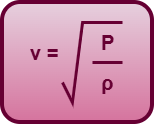
- The value of speed of sound in air calculated using this formula does not agree with the experimental value.
In this article, we will learn about Laplace’s Correction.
Laplace’s Correction-
After a long time, Newton gave his formula, Laplace, a French scholar succeeded in explaining the exact cause of discrepancy between the theoretical and experimental values of the speed of sound in air.
Laplace pointed out that Newton’s assumption was wrong.
Laplace suggested that-
- In a sound wave, compressions and rarefactions change quickly at a place.
- The changes are too fast for a gas element to be able to exchange heat with the surroundings.
- When a small volume of air gets compressed, its temperature rises. Before it could conduct heat to the surroundings, a rarefaction arrives and the small volume of air gets cooler.
- It means that neither the heat is transferred to the surroundings during compression and nor the heat is taken from the surroundings during rarefaction.
- Thus, no exchange of heat is possible when a sound wave passes through a gas.
- Such a process in which volume and pressure of a gas changes but no heat is exchanged with the surroundings is called an adiabatic process.
In such a process, the gas satisfies the equation-
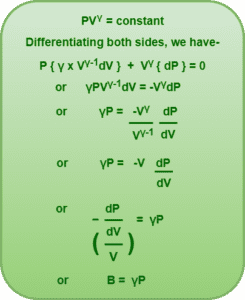
It means the bulk modulus of an ideal gas in an adiabatic process is equal to the γ times the pressure of the gas.
Substituting in the formula v = √(B/ρ), we get-
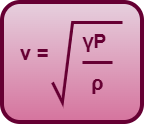
This is modified Newton’s formula after Laplace’s correction for the speed of sound in a gas. Here, γ depends on the nature of gas.
Calculating Speed of Sound Using Modified Newton’s Formula-
Let us now use modified Newton’s formula to calculate the speed of sound in air at NTP.
At NTP, we have-
- P = 1 atm = 1.013 x 10⁵ Pa
- ρ = 1.293 kg/m3
- γ = 1.41 (for air)
Substituting in the formula, we have-
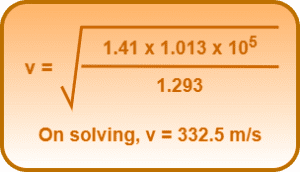
This value agrees fairly well with the experimental value of the speed of sound in air at NTP.
Hence, the validity of Laplace’s correction is justified and the above formula is the correct relation for the speed of sound in any gaseous medium.
Test Your Concepts-
Laplace’s Correction in Newton’s Formula
Next Article-
Factors Affecting Speed of Sound In Gas
Get more notes & other study material of the Chapter Waves.